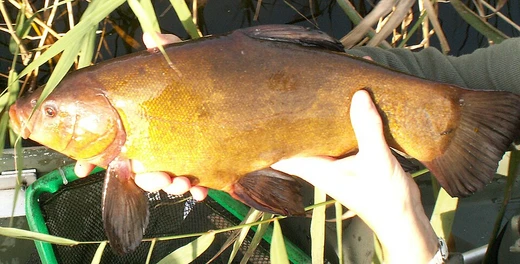
Minnow
Small freshwater fish used widely as bait and sometimes as food.

Wikipedia / Wikimedia Commons
Minnow is a common name for many small freshwater fish species, mostly from the family Cyprinidae and especially the subfamily Leuciscinae. In Ireland, they are called pinkeens. Anglers often consider the smaller fish within Leuciscinae to be the "true" minnows.
Several specific types exist. The bluntnose minnow (Pimephales notatus) is a common bait fish in North America, tolerating a wide range of water conditions. Its snout overhangs its mouth, giving it a blunt appearance, and it has a dark line from the gill cover to a black spot at the tail base. Adults average about 5 cm long. The common shiner (Notropis cornutus) lives almost exclusively in streams and is another frequent bait fish. It has nine rays on its anal fin and a terminal mouth, with bluish silver sides and a greenish blue back. Males develop a rose-colored tail and anal fin during breeding. This shiner grows 5–10 cm in its first year and reaches about 13 cm as an adult. The chub shiner is Notropis potteri. The common emerald shiner (Notropis atherinoides atherinoides) is most abundant in the Great Lakes, especially Lake Erie. It gets its name from a greenish emerald band running from the gill cover to the tail. It has a short, rounded snout, unlike the silver shiner, which has a longer snout and larger eye. It averages about 6 cm in length and is a highly favored bait fish in the Lake Erie region of Ohio.
Other fish called minnows include the cheat minnow (genus Pararhinichthys), cutlips minnow (Exoglossum), desert minnows (Dionda), Eurasian minnows (Phoxinus), fathead minnow (also rosy-red minnow, Pimephales), loach minnow (Rhinichthys), Balkan minnows (Pelasgus), Ozark minnow (Notropis), pikeminnows (Ptychocheilus), pugnose minnow (Opsopoeodus), Anatolian minnows (Ladigesocypris), silverjaw or longjaw minnow (Ericymba), silvery minnows (Hybognathus), suckermouth minnows (Phenacobius), and White Cloud Mountain or Vietnamese cardinal minnow (Tanichthys). In the Southern Hemisphere, some fish in the family Galaxiidae, especially the genus Galaxias, are also called minnows. In Southeast Asia, danionins such as razorbelly minnows are included. Other examples are the Drakensberg minnow (Labeobarbus aspius) from the Democratic Republic of the Congo, the Maluti minnow (Pseudobarbus quathlambae) from Lesotho, and the Falklands minnow, a local name for the common galaxias in the Falkland Islands. T
- common_name
- Minnow
- also_known_as
- Pinkeen (in Ireland)
- family
- Cyprinidae
- subfamily
- Leuciscinae
- typical_size
- 5–13 cm (2.0–5.1 in)
- primary_use
- Bait fish
- distribution
- Northern America, Great Lakes, Eurasia, Southern Hemisphere, Southeast Asia
Lore & Background
Minnows encompass many species, including the bluntnose minnow (Pimephales notatus), a primary bait fish for Northern America with high tolerance for variable water qualities. Its snout overhangs the mouth, and it has a dark lateral line from the opercle to the tail, where a large black spot is located. The common shiner (Notropis cornutus) is almost exclusively a stream dweller, identified by nine rays on its anal fin and a terminal mouth; males gain a rose colored tail and anal fin during breeding season. The common emerald shiner (Notropis atherinoides atherinoides) is most abundant in the Great Lakes, especially Lake Erie, and is named for a greenish emerald band from the gill cover to the tail.
Reader's Guide
Minnows are significant primarily as bait fish for anglers, with species like the bluntnose minnow and common shiner being widely used in Northern America. The common emerald shiner is particularly valued in the Lake Erie region of Ohio, where many fishermen hold it over all other bait. Beyond bait, minnows have been used as food by some Native American cultures, and if small enough, they can be eaten whole. Conservation concerns are minimal: minnows breed with slight rainfall and within a wide temperature range, and climate change poses a 'negligible' threat to their reproduction. They are flexible in attaining pre-spawning fitness, avoiding 'skipped spawning' decisions amid climatic variabilities. The term 'minnow' also applies to unrelated fish in the Southern Hemisphere (family Galaxiidae), Southeast Asian danionins, and even the bioluminescent bristlemouth fish of the deep (Cyclothone sp.), reflecting the name's broad usage.
Did You Know?
- Minnows are also known as pinkeens in Ireland.
- The bluntnose minnow has a very high tolerance for variable water qualities.
- The common emerald shiner is most abundant in Lake Erie of the Great Lakes.
- Some Native American cultures have used minnows as food.
More in Freshwater Fish 1-19
Spotted an error? Know more?
This is a living reference — every entry is fact-audited, and reader corrections feed straight into our audit queue. Suggest an edit · See this site's audit record