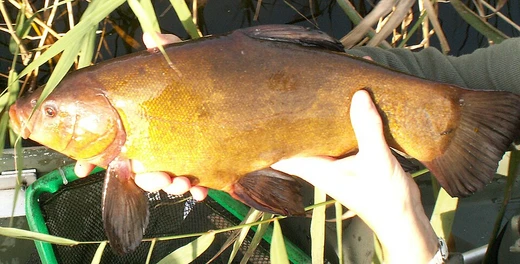
Pumpkinseed
A small, colorful sunfish native to eastern North America.
The pumpkinseed (Lepomis gibbosus) is a small to medium-sized freshwater fish endemic to eastern North America. It is also known as sun perch, pond perch, common sunfish, punkie, sunfish, sunny, and kivver, and belongs to the sunfish family (Centrarchidae). Its common name derives from its body shape, which resembles a pumpkin seed, and it is widely recognized by the bright red spot at the tip of its ear flap.
- Scientific name
- Lepomis gibbosus
- Family
- Centrarchidae (sunfish family)
- Native range
- Eastern North America, from New Brunswick to South Carolina, inland to Iowa
- Typical length
- About 10 cm (4 in), up to 28 cm (11 in)
- Typical weight
- Less than 1 pound (450 g); world record 1 lb 8 oz (680 g)
- Conservation status
- Least Concern (IUCN); not listed by CITES
- Invasive in
- Europe (EU Union list since 2019)
Lore & Background
The pumpkinseed sunfish is vibrantly colored, with orange, green, yellow, or blue speckles, a yellow-orange breast, and vertical bars on its sides. It has a small mouth with an upper jaw stopping under the eye, and its defining characteristic is the orange-red spot on the margin of its black gill cover. The pectoral fins may be amber or clear, and the dorsal spines are black. It is very similar to the larger bluegill, but can be distinguished by the crimson half-moon spot on its opercular flap and seven or eight duller vertical bands on its sides.
Pumpkinseeds live in warm, calm lakes, ponds, and pools of creeks with plenty of vegetation, preferring clear water and shallow, protected areas near shore. They are active during the day, feeding at all water levels, with heaviest feeding in the afternoon. They travel in schools that may include bluegills and other sunfish. They are more tolerant of low oxygen levels than bluegills but less tolerant of warm water. Adults tend to travel in groups of two to four in slightly deeper, covered waters, and rest at night near the bottom or in shelter.
In late spring or early summer, when water temperatures reach 55–63 °F (13–17 °C), males build nests in shallow water on sand or gravel bottoms. Nests are arranged in colonies of three to 15, often near bluegill colonies, and the two species interbreed. Females produce 1,500 to 1,700 eggs, which hatch in as few as three days. Males guard the offspring for about 11 days. Young fish grow to about 2 inches in their first year, reach sexual maturity by age two, and in nature most live six to eight years.
Reader's Guide
The pumpkinseed sunfish is a common and widespread species in its native eastern North America, where it plays a role in freshwater ecosystems as a carnivorous predator of insects, small molluscs, crustaceans, worms, and even smaller fish. Its ability to consume mosquito larvae makes it beneficial in controlling insect populations. The species has been introduced throughout most of North America and is now found from the Pacific Coast to the Atlantic Coast, though it remains primarily in the northeastern United States.
In Europe, the pumpkinseed is considered an invasive species. Since its introduction, it has been able to outcompete native fish, leading to its inclusion in 2019 on the European Union's list of Invasive Alien Species of Union concern. This listing prohibits its import, breeding, transport, commercialization, or intentional release across the entire EU. In the United Kingdom, its range is believed to be restricted to Southern England and the West Country, with stable populations in East Sussex, West Sussex, and Somerset.
The pumpkinseed's adaptations include a camouflaged skin pattern, sharp spines on the dorsal and anal fins, and a lateral line system to detect predators and prey. Its brightly colored gill plate, with an eye spot, can make the fish appear up to four times larger when flared, serving as both protection and a display of dominance. In southern regions, individuals have developed larger mouths and jaw muscles to crack the shells of mollusks. The species is considered Least Concern by the IUCN and is not listed by CITES, though its spawning grounds can be disturbed by shoreline development and erosion.
Did You Know?
- The pumpkinseed's scientific name Lepomis gibbosus means 'scaled gill cover' and 'humped' in Greek.
- The world record pumpkinseed weighed 1 pound 8 ounces (680 g) and was caught at Honeoye Lake in Upstate New York in 2016.
- Pumpkinseeds have been known to interbreed with bluegills, as they often build nests near bluegill colonies.
- In the European Union, since 2019, the pumpkinseed cannot be imported, bred, transported, commercialized, or intentionally released into the environment.
More in Freshwater Fish 1-19
Spotted an error? Know more?
This is a living reference — every entry is fact-audited, and reader corrections feed straight into our audit queue. Suggest an edit · See this site's audit record